
Alibaba Qwen Releases Qwen3.8-Omni-Flash: A 1M-Context Omni-Modal Model Built Around Agentic Audio-Video Understanding and Tool Use
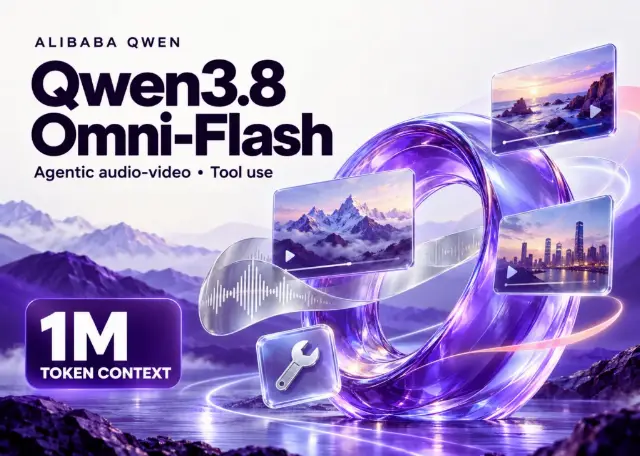
Alibaba Qwen releases Qwen3.8-Omni-Flash, an API-only agentic omni-modal model with 1M context, native audio-video reasoning, and tool use.
Alibaba’s Qwen team has released Qwen3.8-Omni-Flash. They called it its first omni-modal model built around agentic capabilities. It accepts text, images, audio, and video, and it returns text. Audio-video understanding, reasoning, and tool use sit inside one model. The stated workflow is simple: understand the content, plan the task, execute with tools, deliver the result.
Is it deployable? Yes, as a hosted API today. It is live on QwenCloud, Alibaba Cloud Model Studio, and Qwen Studio. No open weights were announced at launch, so self-hosting is not an option.
What is Qwen3.8-Omni-Flash
The Qwen3.8-Omni-Flash is built on the Qwen3.8-Flash-Next architecture. That base model shipped with open weights in August 2026.
The context window is 1M tokens. QwenCloud lists 991K max input and 131K max output. Max reasoning length is 262K tokens.
Output is text only. The Model Studio docs point developers to Qwen3.5-Omni when they need generated speech. Thinking is on by default, with reasoning_effort set to xhigh. Setting it to none disables thinking.
The API follows both the DashScope and OpenAI protocols. It works with Chat Completions and the Responses API. Function calling, web search, structured outputs, context caching, and batch calls are supported.
Agentic Perception for Long Video
Most video models read a long file from start to finish. That holds even when the answer sits in 3 minutes of footage.
Qwen research team describes a different path. The agent starts from the question. It decides what to watch and hear. It then gathers evidence over several coarse-to-fine rounds. Compute and tokens go to the segments that matter.
The research team reports the result on OmniVideoBench. Accuracy rises from 63.4 to 67.8. Token use drops from 145,736 to 79,117. That is about 45.7% fewer tokens.
Reported Benchmarks
All figures here come from Qwen. Independent results were not available at publication.
- Across 29 evaluations, the average score improves more than 25% over Qwen3.5-Omni-Plus.
- WildClawBench-MM records a 36.5-point increase, while AgenticVBench posts a gain of 22.3 points.
- UniClawBench achieves a score of 69.6.
- LongAudioSpan improves by 8.3 points, alongside a 9.6-point increase on OmniVideoBench.
- OmniCap-IF CSR rises by 8.5 points, while ISR increases by 14.1 points.
Audio-visual performance is described as approaching Gemini 3.8 Flash, with overall audio performance claimed to exceed Gemini 3.8 Flash. Agent performance gains across WildClawBench-MM and UniClawBench are reported to average +19.5 points.
🚀 Introducing Qwen3.8-Omni-Flash—the first omni-modal model in the Qwen lineup designed around agentic capabilities!
September 18, 2026
A single model combines native audio-video understanding with reasoning and tool use, moving from interpreting content to planning tasks, executing them with tools, and delivering results.
Highlights: 🥳
-… pic.twitter.com/iJypeohw7y
Pricing and Input Limits
QwenCloud pricing is $0.15 per 1M input tokens and $0.47 per 1M output tokens, with implicit cache hits priced at $0.016 per 1M tokens.
Reported cost savings compared with Qwen3.5-Omni-Plus are substantial: hourly audio input costs fall by over 98%, and hourly audio-visual input costs drop by over 93%. Video input costs are reported to decrease by about 89%.
Main usage limits:
- Video files submitted by URL can be up to 2 hours long and 2 GB in size.
- Audio files can have a duration of up to 3 hours.
- Audio input is supported across 113 languages and dialects.
- Video sampling rates of up to 15 fps deliver consistent results.
- Two-channel stereo and four-channel FOA spatial audio through
use_multichannel. - The service is available across 6 regions: Beijing, Singapore, Hong Kong, Tokyo, Frankfurt, and Virginia.
A call through the OpenAI SDK requires only a few lines:
Copy CodeCopiedUse a different Browserimport os
from openai import OpenAI
client = OpenAI(
api_key=os.environ["DASHSCOPE_API_KEY"],
base_url=os.environ["DASHSCOPE_BASE_URL"],
)
completion = client.chat.completions.create(
model="qwen3.8-omni-flash",
messages=[{"role": "user", "content": [
{"type": "video_url", "video_url": {"url": os.environ["VIDEO_URL"]}},
{"type": "text", "text": "List the key moments with timestamps."},
]}],
modalities=["text"],
stream=True,
)
for chunk in completion:
if chunk.choices and chunk.choices[0].delta.content:
print(chunk.choices[0].delta.content, end="")Open-Source Tools: Qwen-MM-Plugins and Qwen-Live Harness
Because the model produces text output, media processing is handled by tools. The Qwen team is making 2 projects open source to enable this workflow.
Qwen-MM-Plugins is now available under Apache-2.0, with the tagline ‘Make any agent harness multimodal-native.’ Capabilities are installed individually as a Skill, with an optional MCP server. A guided installer supports Claude Code, CodeBuddy, Codex, Qoder, OpenClaw, Qwen Code, and Gemini CLI.
The launch demos correspond to these Omni capabilities:
omni-memorybuilds an audio-visual memory of a long video.omni-video2noteconverts a tutorial video into an illustrated PDF.omni-chatcutcovers Music-to-MV, movie commentary, and speaker-preserving video translation.
A core plugin lets the main model read local images and video frames natively. The README notes one current gap. Most harnesses cannot feed audio to the main model natively yet. Audio is routed through the API for now.
Interactive Explainer
Key Takeaways
- Text, images, audio, and video can all serve as inputs to Qwen3.8-Omni-Flash, which generates text in response.
- Its features include a 1M-token context window, function calling, web search, and thinking enabled by default.
- With agentic perception, the OmniVideoBench score rises from 63.4 to 67.8 while token use drops by about 45.7%.
- QwenCloud charges $0.15 for input and $0.47 for output per 1M tokens.
- At launch, access is limited to the API, with Qwen-MM-Plugins available under Apache-2.0 for agent harnesses.
Asif Razzaq
Website |Asif Razzaq, CEO of Marktechpost AI Media Inc., is a forward-thinking entrepreneur and engineer dedicated to using Artificial Intelligence to benefit society. His latest venture is Marktechpost, an Artificial Intelligence Media Platform offering detailed reporting on machine learning and deep learning developments. Its coverage combines technical accuracy with explanations accessible to a broad readership. With more than 2 million views each month, the platform demonstrates strong audience appeal.
Alibaba’s Qwen team has released Qwen3.8-Omni-Flash. They called it its first omni-modal model built around agentic capabilities. It accepts text, images, audio, and video, and it returns text. Audio-video understanding, reasoning, and tool use sit inside one model. The stated workflow is simple: understand the content, plan the task, execute with tools, deliver the result.
Is it deployable? Yes, as a hosted API today. It is live on QwenCloud, Alibaba Cloud Model Studio, and Qwen Studio. No open weights were announced at launch, so self-hosting is not an option.
What is Qwen3.8-Omni-Flash
The Qwen3.8-Omni-Flash is built on the Qwen3.8-Flash-Next architecture. That base model shipped with open weights in August 2026.
The context window is 1M tokens. QwenCloud lists 991K max input and 131K max output. Max reasoning length is 262K tokens.
Output is text only. The Model Studio docs point developers to Qwen3.5-Omni when they need generated speech. Thinking is on by default, with reasoning_effort set to xhigh. Setting it to none disables thinking.
The API follows both the DashScope and OpenAI protocols. It works with Chat Completions and the Responses API. Function calling, web search, structured outputs, context caching, and batch calls are supported.
Agentic Perception for Long Video
Most video models read a long file from start to finish. That holds even when the answer sits in 3 minutes of footage.
Qwen research team describes a different path. The agent starts from the question. It decides what to watch and hear. It then gathers evidence over several coarse-to-fine rounds. Compute and tokens go to the segments that matter.
The research team reports the result on OmniVideoBench. Accuracy rises from 63.4 to 67.8. Token use drops from 145,736 to 79,117. That is about 45.7% fewer tokens.
Reported Benchmarks
All figures here come from Qwen. Independent results were not available at publication.
- Across 29 evaluations, the average score improves more than 25% over Qwen3.5-Omni-Plus.
- WildClawBench-MM records a 36.5-point increase, while AgenticVBench posts a gain of 22.3 points.
- UniClawBench achieves a score of 69.6.
- LongAudioSpan improves by 8.3 points, alongside a 9.6-point increase on OmniVideoBench.
- OmniCap-IF CSR rises by 8.5 points, while ISR increases by 14.1 points.
Audio-visual performance is described as approaching Gemini 3.8 Flash, with overall audio performance claimed to exceed Gemini 3.8 Flash. Agent performance gains across WildClawBench-MM and UniClawBench are reported to average +19.5 points.
🚀 Introducing Qwen3.8-Omni-Flash—the first omni-modal model in the Qwen lineup designed around agentic capabilities!
September 18, 2026
A single model combines native audio-video understanding with reasoning and tool use, moving from interpreting content to planning tasks, executing them with tools, and delivering results.
Highlights: 🥳
-… pic.twitter.com/iJypeohw7y
Pricing and Input Limits
QwenCloud pricing is $0.15 per 1M input tokens and $0.47 per 1M output tokens, with implicit cache hits priced at $0.016 per 1M tokens.
Reported cost savings compared with Qwen3.5-Omni-Plus are substantial: hourly audio input costs fall by over 98%, and hourly audio-visual input costs drop by over 93%. Video input costs are reported to decrease by about 89%.
Main usage limits:
- Video files submitted by URL can be up to 2 hours long and 2 GB in size.
- Audio files can have a duration of up to 3 hours.
- Audio input is supported across 113 languages and dialects.
- Video sampling rates of up to 15 fps deliver consistent results.
- Two-channel stereo and four-channel FOA spatial audio through
use_multichannel. - The service is available across 6 regions: Beijing, Singapore, Hong Kong, Tokyo, Frankfurt, and Virginia.
A call through the OpenAI SDK requires only a few lines:
Copy CodeCopiedUse a different Browserimport os
from openai import OpenAI
client = OpenAI(
api_key=os.environ["DASHSCOPE_API_KEY"],
base_url=os.environ["DASHSCOPE_BASE_URL"],
)
completion = client.chat.completions.create(
model="qwen3.8-omni-flash",
messages=[{"role": "user", "content": [
{"type": "video_url", "video_url": {"url": os.environ["VIDEO_URL"]}},
{"type": "text", "text": "List the key moments with timestamps."},
]}],
modalities=["text"],
stream=True,
)
for chunk in completion:
if chunk.choices and chunk.choices[0].delta.content:
print(chunk.choices[0].delta.content, end="")Open-Source Tools: Qwen-MM-Plugins and Qwen-Live Harness
Because the model produces text output, media processing is handled by tools. The Qwen team is making 2 projects open source to enable this workflow.
Qwen-MM-Plugins is now available under Apache-2.0, with the tagline ‘Make any agent harness multimodal-native.’ Capabilities are installed individually as a Skill, with an optional MCP server. A guided installer supports Claude Code, CodeBuddy, Codex, Qoder, OpenClaw, Qwen Code, and Gemini CLI.
The launch demos correspond to these Omni capabilities:
omni-memorybuilds an audio-visual memory of a long video.omni-video2noteconverts a tutorial video into an illustrated PDF.omni-chatcutcovers Music-to-MV, movie commentary, and speaker-preserving video translation.
A core plugin lets the main model read local images and video frames natively. The README notes one current gap. Most harnesses cannot feed audio to the main model natively yet. Audio is routed through the API for now.
Interactive Explainer
Key Takeaways
- Text, images, audio, and video can all serve as inputs to Qwen3.8-Omni-Flash, which generates text in response.
- Its features include a 1M-token context window, function calling, web search, and thinking enabled by default.
- With agentic perception, the OmniVideoBench score rises from 63.4 to 67.8 while token use drops by about 45.7%.
- QwenCloud charges $0.15 for input and $0.47 for output per 1M tokens.
- At launch, access is limited to the API, with Qwen-MM-Plugins available under Apache-2.0 for agent harnesses.
Asif Razzaq
Website |Asif Razzaq, CEO of Marktechpost AI Media Inc., is a forward-thinking entrepreneur and engineer dedicated to using Artificial Intelligence to benefit society. His latest venture is Marktechpost, an Artificial Intelligence Media Platform offering detailed reporting on machine learning and deep learning developments. Its coverage combines technical accuracy with explanations accessible to a broad readership. With more than 2 million views each month, the platform demonstrates strong audience appeal.
عبدالرحمن ربيع
Software Engineer & AI Builder
مطور برمجيات متكامل ومصمم جرافيك مع أكثر من 4 سنوات خبرة في بناء تطبيقات الويب الحديثة باستخدام PHP و JavaScript و HTML و CSS. خلفية قوية في تصميم UI/UX واستخدام متقدم لأدوات الذكاء الاصطناعي لتعزيز كفاءة التطوير والأتمتة واتخاذ القرارات. حاصل على ماجستير تنفي...
مقالات ذات صلة
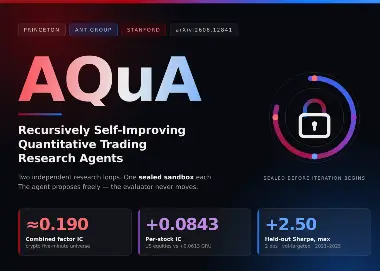
باحثون من برينستون وآنت جروب وستانفورد يقدمون AQuA: إطار عمل وكيل من جزأين لاكتشاف العوامل المستقلة وتطوير النماذج في التمويل الكمي
اقرأ المقال
Best Open-Source Agent Harnesses for Local LLMs in 2026
اقرأ المقال
المكدس الفائق: مجموعة بداية Laravel مع فتيلة و NativePHP
اقرأ المقال
التعليقات (0)
كن أول من يعلّق على هذا المقال.